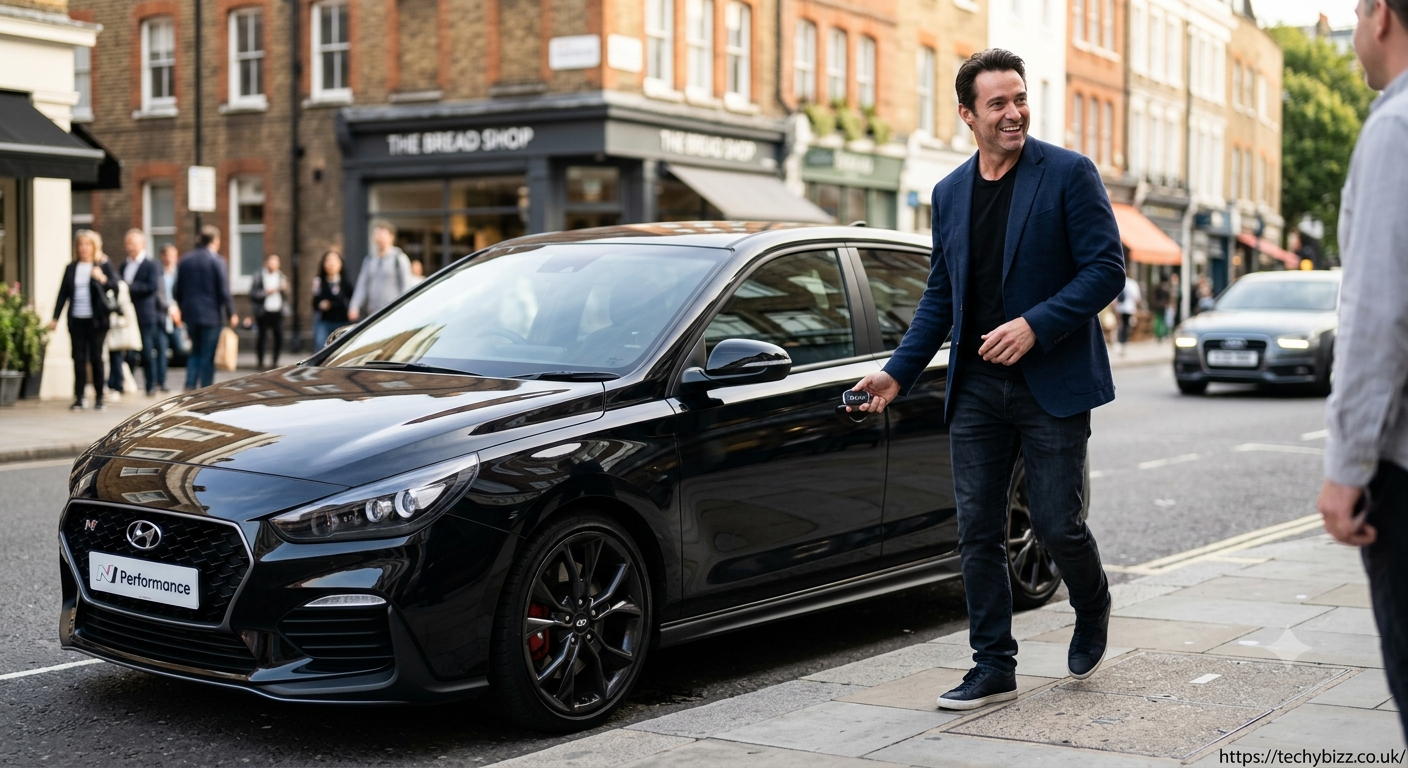
The Hyundai i30 N is one of the most exciting performance-focused hot hatches produced by Hyundai. Developed with a strong emphasis on driving enjoyment, the i30 N combines a practical hatchback body with a powerful turbocharged engine, sporty suspension, advanced performance technology and aggressive styling. Unlike many ordinary compact cars, it is designed to feel entertaining on winding roads and capable on a racetrack while still being suitable for everyday driving. Hyundai describes the i30 N as a car that balances racetrack-ready dynamics with daily usability.
What Is the Hyundai i30N?
The Hyundai i30 N is the high-performance version of Hyundai’s i30 compact hatchback. The N badge represents Hyundai’s performance division, and the i30 N became an important model in establishing Hyundai as a serious competitor in the performance-car market. Its development was influenced by motorsport and Hyundai’s N performance program, with the goal of creating a car that could deliver excitement without sacrificing everyday practicality.
One of the biggest strengths of the i30 N is its versatility. It can be used as a normal hatchback for commuting, shopping and longer journeys, but its performance hardware allows it to become considerably more aggressive when the driver selects its sportier settings. Depending on specification and market, the car can feature performance-focused suspension, an electronically controlled limited-slip differential, launch control, rev matching and an active variable exhaust system.
Hyundai i30 N Engine and Performance
At the heart of the Hyundai i30 N is a 2.0-litre turbocharged four-cylinder petrol engine. Hyundai’s Performance version produces up to 280 PS and 392 Nm of torque, while the standard version is rated at 250 PS and 353 Nm. Both versions have a claimed top speed of 250 km/h according to Hyundai’s global specifications.
The engine is designed to provide strong torque across a useful part of the rev range rather than delivering all of its performance only at high engine speeds. This makes the i30 N responsive during normal driving while giving it plenty of punch when the throttle is opened. In markets such as Australia, the current i30 N is listed with 206 kW and 392 Nm, and Hyundai quotes a 0–100 km/h time of 5.3 seconds for the automatic version.
This combination gives the i30 N enough performance to compete with established hot hatches while retaining the practicality expected from a compact Hyundai.
Transmission Options
One of the most interesting developments for the i30 N was the introduction of Hyundai’s eight-speed wet dual-clutch transmission, known as N DCT. The system includes steering-wheel-mounted paddle shifters and performance-oriented software designed to make gear changes quicker and more engaging.
Drivers who prefer traditional involvement can choose the six-speed manual transmission where it is offered. The manual version provides a more direct connection between the driver and engine and includes features such as rev matching. For enthusiasts who enjoy changing gears themselves, the manual remains an important part of the i30 N’s appeal.
The N DCT, however, provides impressive convenience for daily driving while allowing the driver to take control through the paddles. Hyundai also developed several special performance functions for the transmission. N Grin Shift, for example, temporarily maximizes performance for up to 20 seconds, while N Power Shift is designed to maintain strong acceleration during upshifts.
Handling and Driving Experience
Straight-line speed is only part of the Hyundai i30 N experience. The car’s handling is arguably one of its most important characteristics. Hyundai has equipped the i30 N with performance-focused suspension and steering systems, while the available electronic limited-slip differential helps manage power through corners.
The N Corner Carving Differential is designed to improve traction and stability when braking, entering and exiting corners. The car also offers several adjustable driving settings through the N Grin Control System, allowing the driver to change characteristics such as engine response, suspension, steering, exhaust sound, stability control and differential behavior.
This adjustability makes the i30 N particularly appealing because it does not have to behave the same way all the time. A calmer setting can make everyday driving easier, while the more aggressive modes can transform the car into a much more focused performance machine.
Exterior Design
The Hyundai i30 N has a distinctive appearance that separates it from the regular i30. The front end features a wider, performance-oriented grille and sporty lighting, while the body includes aggressive bumpers, side skirts and N-specific styling details.
At the rear, the car’s large exhaust outlets and sporty bumper immediately communicate its performance intentions. Hyundai also uses a rear spoiler with an integrated triangular brake light, while certain versions receive lightweight 19-inch forged alloy wheels. These wheels contribute not only to the appearance but also to the car’s performance by reducing weight.
Performance Blue has also become strongly associated with Hyundai’s N models. Combined with red detailing and the N badges, the styling gives the i30 N a distinctive identity without requiring an exotic sports-car body.
Interior and Technology
Inside, the i30 N combines a practical compact-car layout with performance-focused details. Depending on specification, drivers can find N-branded controls, sporty seats, performance displays and a steering wheel with dedicated buttons for functions such as N Mode and N Grin Shift.
The available N Light Seats use lightweight construction and pronounced side bolsters to provide greater support during enthusiastic cornering. Hyundai also provides a performance-oriented instrument display capable of showing information such as engine oil temperature, torque and turbo boost.
Technology is another part of the package. Hyundai’s i30 N can offer a large touchscreen, smartphone connectivity through Apple CarPlay and Android Auto, navigation and Bluelink connected-car services depending on market and specification. The Performance Driving Data System can display information including power, torque, turbo boost, G-force and lap or acceleration times.
Safety and Everyday Practicality
Although the Hyundai i30 N is designed around performance, it is still a practical hatchback. That makes it more useful as an everyday vehicle than many dedicated sports cars. The hatchback configuration provides useful cargo space, while the cabin can accommodate passengers without requiring the compromises associated with a two-seat performance car.
Safety equipment varies by market and model year, but Hyundai has incorporated its SmartSense driver-assistance technologies into the i30 N. Features can include forward collision warning, autonomous emergency braking, lane-keeping assistance and driver-attention monitoring.
The combination of performance and practicality is one of the strongest reasons to consider the i30 N. A driver can enjoy a sporty vehicle during the weekend without necessarily needing a second car for everyday transportation.
Hyundai i30 N Fuel Economy and Ownership
Fuel economy depends on the exact model, transmission, driving conditions and market. Hyundai’s European information lists the 280 PS i30 N at approximately 8.0–8.4 litres per 100 km under the relevant WLTP test range, although real-world consumption can be higher when the car is driven aggressively.
Running costs also depend on how the vehicle is used. Performance tyres, brakes and other components can cost more than those of a conventional family hatchback, particularly if the car regularly sees track use. However, the i30 N remains relatively accessible compared with more expensive performance vehicles.
Another consideration is the model’s future. Automotive reporting in 2026 suggests the current i30 N is approaching the end of its lifecycle, while Hyundai has not confirmed a direct replacement timetable. This could make late examples particularly interesting to enthusiasts who want a traditional turbocharged performance hatchback.
Is the Hyundai i30 N Worth Buying?
The Hyundai i30 N makes a strong case for itself because it offers a rare combination of performance, practicality and driving character. The 280 PS Performance version provides serious power, while features such as the electronic limited-slip differential, adjustable driving modes, performance suspension and active exhaust give the car considerable personality.
There are compromises. A performance-focused suspension setup can feel firm, road and tyre noise can be noticeable, and some reviewers have criticized the interior materials and ageing technology compared with newer rivals.
Nevertheless, those weaknesses do not remove the central appeal of the i30 N. It is designed primarily for people who genuinely enjoy driving. Rather than simply adding aggressive styling to a normal hatchback, Hyundai has made substantial mechanical changes to create a car that feels special behind the wheel.
Final Verdict
The Hyundai i30 N has established itself as one of Hyundai’s most memorable performance cars. Its turbocharged 2.0-litre engine, manual and dual-clutch transmission choices, sophisticated chassis technology and aggressive styling make it much more than an ordinary family hatchback.
For drivers who want a practical car that can also deliver serious excitement, the i30 N remains an appealing choice. Its combination of everyday usability and track-inspired engineering is what makes it stand out. With the current generation approaching the later stages of its life cycle, it may also become increasingly interesting to enthusiasts looking for a modern, petrol-powered hot hatch with plenty of character.
Frequently Asked Questions
What engine does the Hyundai i30 N have?
The i30 N uses a 2.0-litre turbocharged four-cylinder petrol engine. The Performance version produces up to 280 PS and 392 Nm of torque.
Is the Hyundai i30 N manual or automatic?
Depending on market and specification, the i30 N is available with a six-speed manual or an eight-speed wet dual-clutch N DCT.
How fast is the Hyundai i30 N?
Hyundai lists a 250 km/h top speed for the i30 N. Some current market specifications quote 0–100 km/h in 5.3 seconds for the automatic version.
Is the i30 N good for daily driving?
Yes. Despite its performance focus, the i30 N retains the practicality of a compact hatchback and offers comfort and connectivity features designed for everyday use.
What makes the i30 N different from a normal i30?
The i30 N adds a more powerful turbocharged engine, performance suspension, stronger brakes, performance-focused electronics, an electronic limited-slip differential, sporty styling and specialized N driving modes.