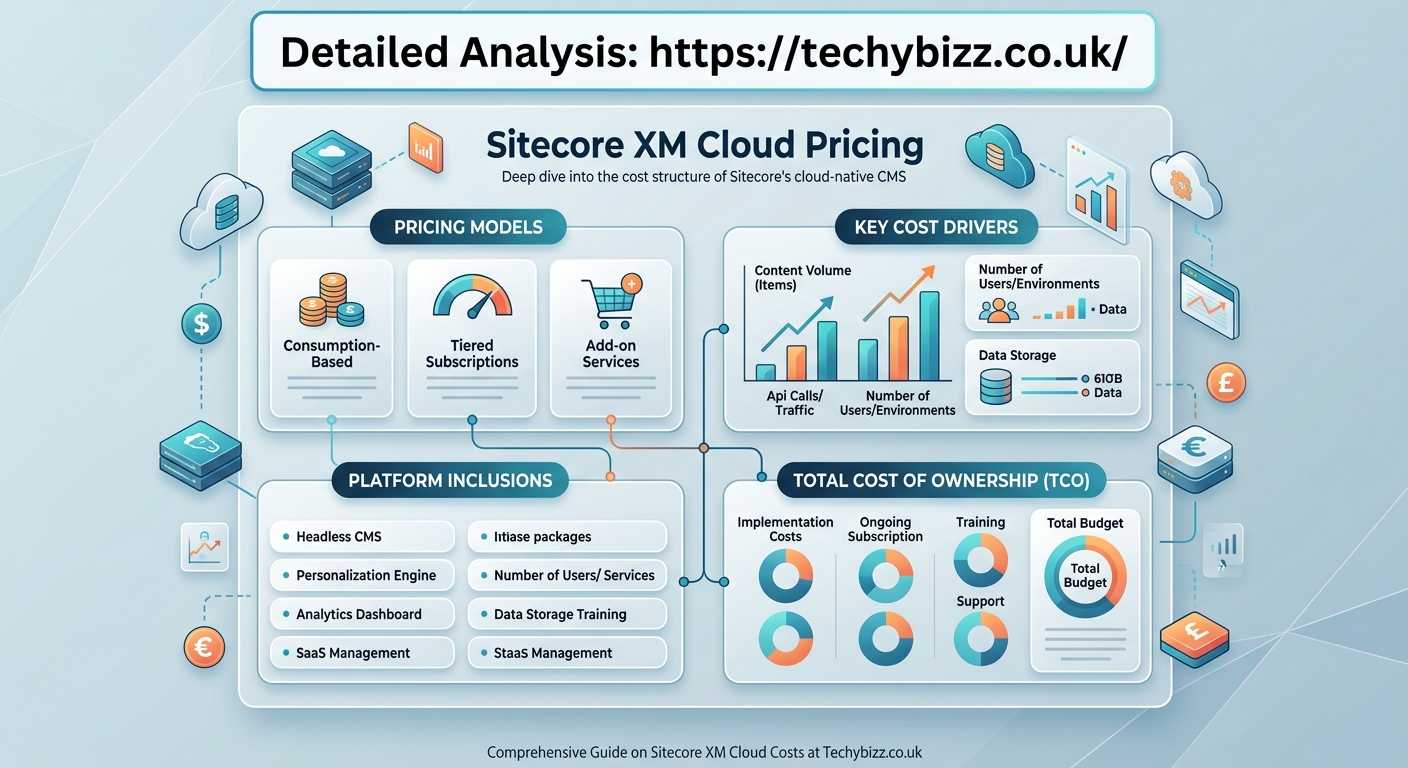
Sitecore XM Cloud pricing is an important consideration for businesses planning to move from traditional content management systems to a modern cloud-based platform. Sitecore XM Cloud is a SaaS content management solution designed for organizations that need scalable content management, headless delivery, visual editing, personalization capabilities, and enterprise-level digital experiences. However, understanding its cost is not as simple as looking for a single monthly subscription number because enterprise software pricing can depend on the products, environments, usage, and licensing terms included in an organization’s agreement.
Sitecore has also expanded its cloud platform over time. Its current materials describe SitecoreAI CMS as the evolution of XM Cloud, while Sitecore’s legal documentation continues to define XM Cloud-specific licensing concepts such as projects, production environments, non-production environments, builds, concurrent users, and visits.
What Is Sitecore XM Cloud?
Sitecore XM Cloud is a cloud-native, SaaS content management platform that allows organizations to create, manage, edit, and deliver digital content without operating the underlying CMS infrastructure themselves. Its headless and API-first architecture allows content to be delivered to websites and other digital channels while giving development teams flexibility over the front-end technology.
Unlike older Sitecore deployments that often required organizations to manage servers, databases, upgrades, scaling, and infrastructure, XM Cloud moves much of that responsibility into a managed cloud service. This can change the way businesses calculate total ownership costs because infrastructure management and traditional software maintenance are handled differently.
Sitecore’s current description of its successor platform says the CMS is fully cloud-native and includes visual authoring and AI capabilities. Sitecore also states that AI capabilities are included in the platform price rather than being charged through separate per-token fees.
Is Sitecore XM Cloud Pricing Public?
One of the most important things to understand about Sitecore XM Cloud pricing is that businesses should not expect a simple public price table comparable to many self-service SaaS products.
Enterprise Sitecore agreements can be structured around the customer’s requirements and the products or services included in the order. Sitecore’s 2026 Order Definitions document identifies several XM Cloud licensing concepts, including production environments, non-production environments, projects, concurrent builds, concurrent users, and visits.
This means the final commercial price can depend on the scope of the deployment rather than one universal price for every customer. Organizations considering XM Cloud generally need to discuss their requirements with Sitecore or an authorized partner to obtain an applicable commercial quote.
What Factors Can Affect XM Cloud Cost?
Several factors can influence the overall cost of a Sitecore XM Cloud implementation.
1. Production Environments
Production environments are an important part of the XM Cloud licensing structure. Sitecore’s order definitions specifically distinguish production environments from non-production environments. The number and configuration of environments required by an organization can therefore be relevant when establishing the appropriate subscription.
A company running one primary website may have different requirements from an enterprise managing multiple brands, regions, or digital properties.
2. Non-Production Environments
Development, testing, staging, and other non-production activities may require separate environments. These environments allow development teams and content teams to test changes before they reach customers.
Because XM Cloud licensing explicitly defines non-production environments, organizations should identify how many development and testing environments they actually need before requesting a quote.
3. Website Visits
Visits are another important concept in Sitecore’s licensing definitions. Sitecore defines a visit based on a person’s interaction with an application using content, data, or functionality originating from the SaaS product.
For organizations with high-traffic websites, estimating expected traffic can therefore be an important part of the pricing discussion. Businesses should use realistic traffic forecasts rather than relying only on current visitor numbers.
4. Concurrent Users
Sitecore’s order definitions also include concurrent users. The documentation states that each production environment supports up to 50 concurrent users under the defined XM Cloud licensing model.
This is particularly relevant for large marketing departments or organizations where many content authors and editors may work in the CMS at the same time.
5. Builds and Deployments
XM Cloud pricing can also be considered alongside development and deployment requirements. Sitecore defines a Build as activities that can include tenant provisioning, developer customization requiring compilation, customization requiring deployment, and automatic update-related deployment. It also defines concurrent builds as the number of builds that can operate simultaneously.
Development teams should therefore consider how frequently they deploy changes and how their CI/CD process will interact with the platform.
What Is Included in XM Cloud?
The exact commercial package depends on the agreement, but XM Cloud is designed to provide a managed SaaS content management foundation rather than simply a traditional CMS license.
The platform supports modern headless content management, visual authoring, cloud deployment, and integration with the broader Sitecore digital experience ecosystem. Sitecore’s current CMS materials also describe AI capabilities as part of the platform rather than charging separately for individual AI tokens.
Organizations should nevertheless distinguish between software subscription costs and other project expenses. A CMS subscription does not automatically mean that every implementation activity is included.
XM Cloud Licensing vs. Implementation Cost
One of the biggest mistakes companies can make when researching Sitecore XM Cloud pricing is treating the subscription as the complete project budget.
An XM Cloud project may also require implementation services, design, development, content migration, integrations, testing, training, and ongoing optimization. If an organization is migrating from an older Sitecore implementation, additional planning and technical work may be required.
Sitecore offers migration-related consulting packages that can include readiness assessments, planning workshops, implementation reviews, go-live preparation, early live support, and advisory hours.
The final project budget should therefore separate the recurring platform agreement from one-time implementation and migration expenses.
Are There Additional Sitecore Costs?
Potential additional costs depend on the organization’s requirements and the services included in its agreement.
For example, businesses may need professional services for implementation or migration. They may also require third-party integrations, custom development, front-end development, analytics, search, or other technologies around the CMS.
The distinction between XM Cloud and older Sitecore Managed Cloud deployments is also important. Older Managed Cloud documentation describes infrastructure components such as Azure App Service, Azure SQL Database, Redis Cache, and monitoring services for traditional PaaS deployments. Those infrastructure-based models should not automatically be treated as the pricing model for current XM Cloud SaaS subscriptions.
Does XM Cloud Reduce Infrastructure Management?
One potential advantage of a SaaS CMS is reduced responsibility for underlying infrastructure.
With traditional self-managed or PaaS-based deployments, organizations may need to consider servers, databases, scaling, upgrades, monitoring, backups, and other operational requirements. XM Cloud changes that operating model by providing a managed SaaS environment.
Sitecore’s service-level documentation separately defines XM Cloud authoring and delivery services and provides an uptime commitment for those services.
This does not mean that every operational cost disappears. Organizations still need developers, content teams, governance, security processes, integrations, and digital experience management. However, the infrastructure responsibilities can be substantially different from an internally managed CMS.
How to Estimate Your Sitecore XM Cloud Budget
Before requesting a Sitecore XM Cloud quote, businesses should prepare a clear requirements document. Start by identifying the number of websites, brands, regions, production environments, development environments, expected traffic, CMS users, integrations, and deployment requirements.
Next, separate the budget into several categories: platform licensing, implementation, migration, development, design, integrations, training, and ongoing support.
A useful approach is to calculate both the initial project cost and the expected recurring cost. This makes it easier to compare XM Cloud with alternative enterprise CMS platforms on a total-cost-of-ownership basis rather than comparing subscription prices alone.
Frequently Asked Questions
How much does Sitecore XM Cloud cost?
There is no single universal public price that applies to every XM Cloud customer. The commercial agreement can depend on requirements such as environments, users, visits, builds, and other licensing considerations.
Is Sitecore XM Cloud cheaper than traditional Sitecore?
The answer depends on the deployment and business requirements. XM Cloud uses a SaaS model that can reduce certain infrastructure and operational responsibilities, but the total cost also includes licensing, implementation, migration, development, and other services.
Does XM Cloud include hosting?
XM Cloud is delivered as a SaaS cloud service, so organizations do not manage the traditional CMS hosting stack in the same way as a self-hosted deployment. Sitecore’s current materials describe it as a cloud-native SaaS CMS.
Does XM Cloud include AI?
Sitecore’s current CMS materials state that AI is included in the platform price and does not carry separate per-token charges.
Can I get a free XM Cloud trial?
Sitecore announced a full-featured free XM Cloud trial in 2025, giving users access to the platform for hands-on evaluation. Availability and current trial terms should be confirmed directly with Sitecore because commercial programs can change.
Final Thoughts on Sitecore XM Cloud Pricing
Sitecore XM Cloud pricing is best understood as an enterprise subscription model rather than a simple fixed monthly CMS fee. The final cost can be influenced by production and non-production environments, visits, concurrent users, builds, projects, and the broader requirements included in the customer agreement.
For an accurate budget, organizations should also account for implementation, migration, development, integrations, training, and ongoing services. The move to SaaS can change infrastructure and maintenance responsibilities, while Sitecore’s current platform direction adds cloud-native CMS and AI capabilities.
The most reliable way to establish the actual cost for a specific business is to prepare detailed technical and business requirements and request a current commercial quote from Sitecore or an authorized partner. This approach provides a more realistic view of both the subscription price and the total cost of adopting XM Cloud.