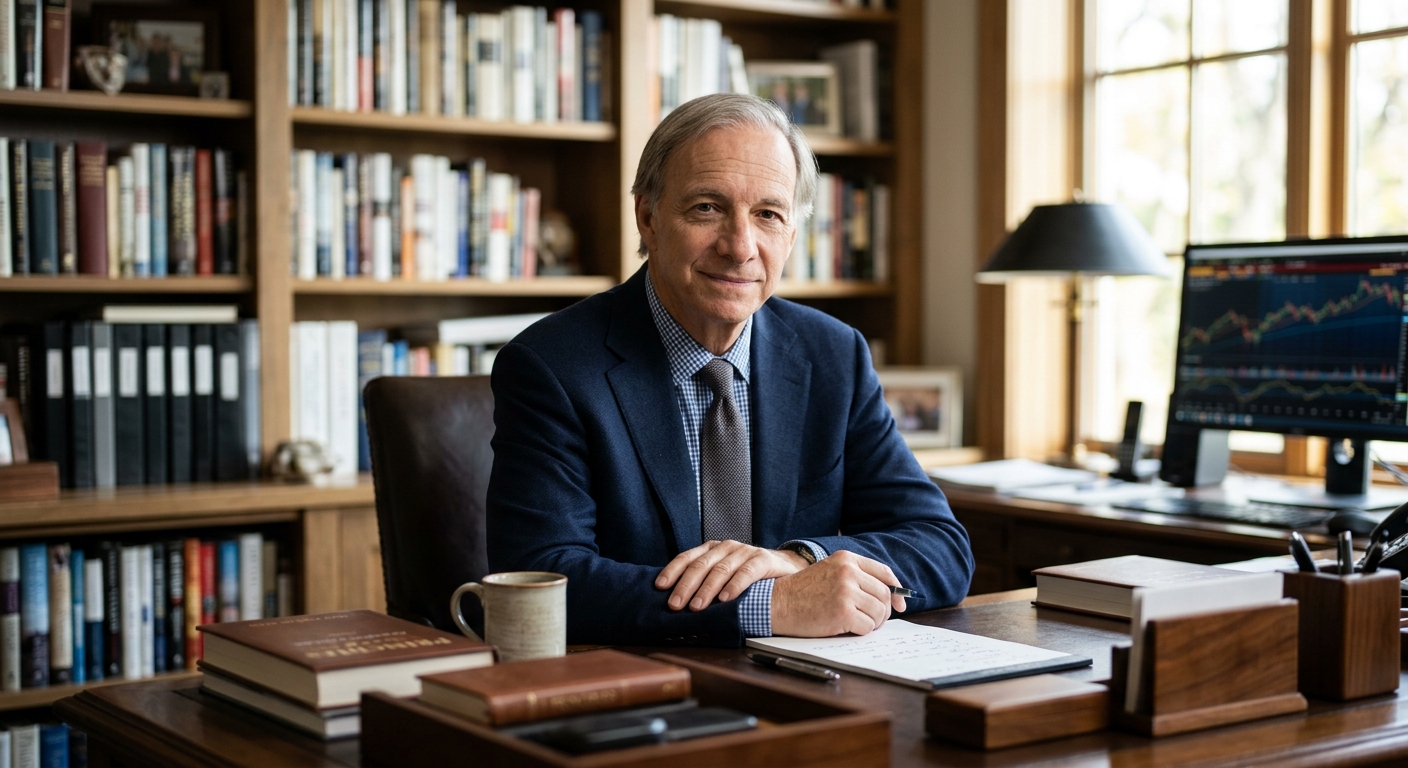
Ray Dalio is an American investor, entrepreneur, author, and the founder of Bridgewater Associates, one of the world’s most prominent hedge fund firms. Over several decades, Dalio developed a reputation for combining economic research, systematic investing, and a distinctive management philosophy built around principles, transparency, and learning from mistakes. Forbes currently lists him as a billionaire and reports that he stepped down as Bridgewater’s CEO in 2017, retired as co-CIO in 2022, and sold his remaining stake in the firm by 2025.
His career is especially notable because it includes both major successes and significant failures. Rather than presenting investing as a process of always being right, Dalio has frequently emphasized learning from mistakes and developing repeatable decision-making principles. His ideas have influenced investors, entrepreneurs, managers, and readers through books such as Principles: Life & Work and Principles for Dealing with the Changing World Order.
Early Life and Education
Ray Dalio was born on August 8, 1949, in Queens, New York. He grew up in a middle-class Long Island neighborhood. His interest in financial markets reportedly began when he was around 12 years old, when he earned money as a golf caddie and began receiving investment tips from golfers.
This early curiosity developed into a serious interest in markets. Dalio attended Long Island University, where he earned his undergraduate degree, and later attended Harvard Business School, earning an MBA. After business school, he worked on Wall Street and gained experience in commodities and financial markets before eventually establishing his own investment business.
His early career was not completely smooth. Dalio has openly discussed mistakes and setbacks that shaped his thinking. His willingness to analyze those experiences later became an important part of the philosophy he promoted through Bridgewater and his books.
The Beginning of Bridgewater Associates
In 1975, Ray Dalio founded Bridgewater Associates after completing his MBA. The company began from a modest apartment in New York, where Dalio focused on economic research, market analysis, and advising clients.
Instead of relying only on traditional investment opinions, Dalio became increasingly interested in understanding the cause-and-effect relationships behind economic events. He studied interest rates, currencies, inflation, debt, international trade, and other factors that could influence financial markets.
Over time, Bridgewater developed into a major institutional investment firm. Forbes reported in 2026 that Bridgewater manages approximately $92 billion and that Dalio had completed his transition away from ownership of the company.
The transformation from a small operation to a global investment organization became one of the defining achievements of Dalio’s career.
Ray Dalio’s Investment Philosophy
A central feature of Ray Dalio’s investment philosophy is the idea that investors should understand economic relationships rather than simply react to individual market movements. His approach has often involved examining how different economic conditions affect asset classes and markets.
Dalio has also emphasized diversification. His well-known discussion of the “Holy Grail of Investing” focuses on combining assets that respond differently to economic environments. The underlying concept is that a portfolio can potentially become more resilient when its investments are not all dependent on the same economic outcome.
Another important element is systematic decision-making. Dalio has argued that investors should identify principles, test ideas against historical evidence, and learn from situations in which their assumptions prove wrong.
However, no investment philosophy eliminates risk. Markets can behave differently from historical patterns, and even sophisticated investment strategies can experience periods of weak performance.
The 1982 Failure That Changed His Career
One of the most important chapters in Dalio’s story occurred in the early 1980s. He publicly anticipated a severe economic downturn, but his forecast was wrong. The U.S. economy instead entered a period of growth.
The mistake had serious consequences for Dalio and Bridgewater. According to Forbes, Dalio lost much of what he had built at the firm, had to lay off employees, and borrowed $4,000 from his father after becoming unable to pay his staff.
Rather than treating the experience only as a financial disaster, Dalio later described it as one of the most important learning experiences of his life. The event reinforced his belief that investors need to recognize their own limitations and actively seek evidence that challenges their assumptions.
This experience became closely connected to one of the recurring themes in his work: pain plus reflection can produce progress. His philosophy encourages people to examine failures objectively and turn them into information that can improve future decisions.
Radical Transparency and Idea Meritocracy
Ray Dalio became particularly well known for the management culture he developed at Bridgewater. Two concepts associated with that culture are radical transparency and idea meritocracy.
The idea behind an idea meritocracy is that decisions should be based on the quality of ideas rather than simply on someone’s position or seniority. Employees are encouraged to express their views, challenge assumptions, and participate in thoughtful disagreement.
Dalio has described radical transparency as a way of making information and disagreements more visible within an organization. Bridgewater used systems and processes designed to record feedback and evaluate people’s strengths and weaknesses.
This approach attracted significant attention because it differs from the management culture of many traditional organizations. At the same time, such a demanding and highly transparent environment is not universally comfortable or suitable for every workplace. Dalio himself has acknowledged that Bridgewater’s culture does not work equally well for everyone.
Principles: Life & Work
In 2017, Ray Dalio published Principles: Life & Work, which became one of his best-known works. The book combines autobiographical experiences with his ideas about decision-making, management, learning, and personal development. Forbes notes that the book became a New York Times bestseller.
The central message is that people can improve their decisions by developing principles—rules or guidelines that help them respond to recurring situations.
Dalio’s framework encourages readers to:
- Accept reality rather than ignoring uncomfortable facts.
- Learn from mistakes.
- Seek honest feedback.
- Remain open-minded.
- Identify weaknesses and strengths.
- Use evidence when making decisions.
- Separate personal ego from the evaluation of ideas.
- Create systems that improve decision-making.
The book helped turn Dalio’s business philosophy into a broader personal-development framework.
Ray Dalio and Economic Research
Beyond individual investments, Dalio has spent decades studying large economic cycles. His research examines relationships involving debt, monetary policy, economic growth, productivity, political developments, and changes in global power.
His later books expanded this focus. Principles for Dealing with the Changing World Order examines historical patterns involving the rise and decline of major powers and the role of debt, internal conflict, and international competition.
Dalio’s economic views have attracted considerable attention, although forecasts about future economies are inherently uncertain. Economic outcomes depend on many variables, and historical patterns do not guarantee that the future will follow the same path.
His more recent work, including How Countries Go Broke: The Big Cycle, continues his examination of debt and long-term economic cycles. Forbes reported in 2025 that the book focuses on the mechanics behind why countries experience severe debt problems.
Ray Dalio’s Wealth and Philanthropy
Ray Dalio has accumulated substantial wealth through his career in investment management. Forbes’ profile, updated in September 2026, lists his real-time net worth at approximately $18.9 billion, while noting that wealth figures can change with market conditions.
However, his financial legacy is not limited to investing. Dalio and his family have also supported philanthropic causes through Dalio Philanthropies. Forbes reports that Dalio has given more than $1 billion to philanthropic causes, including support for areas such as microfinance and public education.
His philanthropic activities represent another major part of his public profile and extend his interest in education, economic opportunity, and long-term social development.
Ray Dalio’s Career Transition
Dalio gradually reduced his formal leadership responsibilities at Bridgewater. He stepped down as CEO in 2017 and later retired as co-CIO in 2022. Forbes reported that he had sold his remaining stake in the firm by 2025.
This transition reflected the broader goal of making Bridgewater less dependent on its founder. Dalio had spent years developing systems, principles, and organizational processes that could continue beyond his direct leadership.
Even after leaving his previous executive roles, Dalio remained active as an author, economic commentator, investor, and philanthropist.
Lessons Associated With Ray Dalio
The ideas associated with Ray Dalio extend beyond hedge funds. His career provides several broad lessons about decision-making and professional development.
First, mistakes can provide useful information. Dalio’s own experience in 1982 became a major influence on his philosophy because the failure forced him to reconsider his assumptions.
Second, disagreement can improve decisions. Dalio believes that thoughtful disagreement can reveal weaknesses in an idea. This concept became a major part of Bridgewater’s culture.
Third, principles can make decisions more consistent. Instead of approaching every problem from scratch, people can create guidelines based on previous experiences.
Finally, success does not eliminate uncertainty. Even experienced investors can make incorrect forecasts. Dalio’s career demonstrates that long-term investing involves both successful decisions and mistakes.
Conclusion
Ray Dalio built his reputation through decades of investing, economic research, organizational experimentation, and a willingness to discuss both success and failure. From starting Bridgewater Associates in 1975 to becoming one of the world’s best-known hedge fund founders, his career has had a significant influence on modern discussions about investing and management.
His philosophy centers on understanding reality, questioning assumptions, learning from mistakes, and developing principles for repeated decisions. His books have expanded these ideas beyond financial markets and introduced them to a much wider audience.
Today, Dalio’s legacy includes Bridgewater, his books, economic research, and philanthropy. His story remains particularly notable because it is not simply a story of financial success; it also includes major mistakes, setbacks, organizational experiments, and the process of turning those experiences into a structured philosophy for decision-making.
Note: Net-worth figures and company assets can change over time, so figures in this article are presented with the relevant 2026 source date.