The FIFA World Cup 2026 was one of the biggest editions in the history of international football. Hosted across Canada, Mexico, and the United States, the tournament introduced a new 48-team format and featured 104 matches across 16 host cities. The competition began on June 11, 2026, and concluded with the final on July 19, 2026.
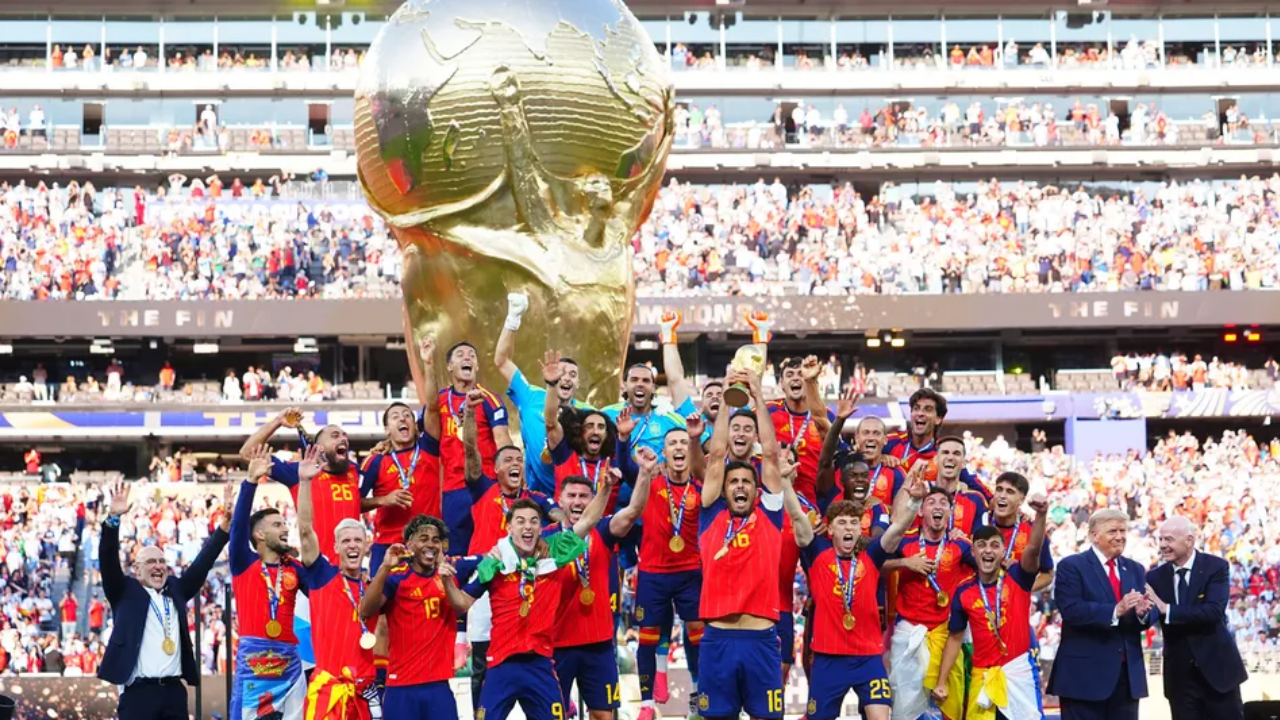
The tournament created several historic moments, including the first World Cup with 48 participating nations and a new Round of 32 knockout stage. Spain ultimately defeated Argentina 1–0 after extra time in the final at New York New Jersey Stadium to become world champions.
FIFA World Cup 2026 Host Countries
The 2026 World Cup was jointly hosted by Canada, Mexico, and the United States. It was the first time that three countries shared hosting duties for a men’s FIFA World Cup.
Canada hosted matches in Toronto and Vancouver, while Mexico staged games in Guadalajara, Mexico City, and Monterrey. The United States hosted the largest number of venues, with matches taking place in Atlanta, Boston, Dallas, Houston, Kansas City, Los Angeles, Miami, New York/New Jersey, Philadelphia, the San Francisco Bay Area, and Seattle.
The three-country hosting model allowed fans to experience football across a huge part of North America. It also gave the tournament a distinct geographical identity, combining major cities, different football cultures, and large modern stadiums.
A New 48-Team World Cup Format
One of the most important changes at the FIFA World Cup 2026 was the expansion from 32 teams to 48. Instead of the traditional eight groups of four, the tournament featured 12 groups of four teams.
The top two teams from every group advanced to the knockout stage, along with the eight best third-place teams. This created a new Round of 32 before the Round of 16. FIFA’s approved format resulted in 104 matches, compared with 64 in the 2022 tournament.
Teams reaching the final therefore had to play eight matches instead of seven. The expanded structure also provided more nations with an opportunity to compete on football’s biggest international stage.
FIFA World Cup 2026 Schedule
The tournament officially began on June 11, 2026, with Mexico facing South Africa in Mexico City. Mexico won the opening match 2–0. The group stage continued through June, with teams competing for places in the newly introduced knockout round.
The Round of 32 was played from June 28 through July 3, followed by the Round of 16 from July 4 to July 7. The quarter-finals took place on July 9–11, while the semi-finals were held on July 14 and July 15.
The third-place play-off was played on July 18, and the final took place on July 19. FIFA’s official schedule confirmed that all 104 matches were distributed across the 16 host cities.
Teams and International Competition
The expanded tournament brought together 48 national teams from across FIFA’s confederations. The larger field meant that several nations made important appearances on the world stage, while traditional football powers also competed for the trophy.
The tournament included teams such as Argentina, Brazil, France, Spain, England, Germany, Portugal, the Netherlands, Belgium, Morocco, Japan, South Korea, Australia, Canada, Mexico, and the United States.
The expanded format also provided opportunities for nations that had historically found qualification difficult. FIFA described the 2026 edition as its first 48-team World Cup and highlighted the broader global participation created by the expansion.
Key Matches of the Group Stage
The group stage produced several memorable results. Germany opened its campaign with a 7–1 victory over Curaçao, while Canada recorded a 6–0 win against Qatar. Argentina defeated Algeria 3–0 before beating Austria 2–0 and later overcoming Jordan 3–1.
England also produced notable results, defeating Croatia 4–2 and later beating DR Congo 2–1. Spain recorded a 4–0 victory over Saudi Arabia, while France defeated Senegal 3–1 and Norway 4–1.
The United States began its home campaign with a 4–1 victory over Paraguay. Mexico also remained unbeaten during its group-stage campaign, including a 3–0 win over Czechia. The variety of results demonstrated the competitive nature of the expanded tournament.
The Knockout Stage
The new Round of 32 immediately added another layer of drama to the competition. Canada defeated South Africa 1–0, Brazil overcame Japan 2–1, France beat Sweden 3–0, and England defeated DR Congo 2–1.
Several matches required penalty shootouts, including Germany versus Paraguay and the Netherlands versus Morocco. Australia and Egypt also went to penalties, with Egypt progressing.
The Round of 16 produced further major results. Morocco defeated Canada 3–0, France beat Paraguay 1–0, Norway defeated Brazil 2–1, and England edged Mexico 3–2. Spain beat Portugal 1–0, while Belgium eliminated the United States with a 4–1 victory. Argentina defeated Egypt 3–2, and Switzerland progressed against Colombia following a penalty shootout.
Quarter-Finals and Semi-Finals
The quarter-finals featured some of the tournament’s strongest teams. France defeated Morocco 2–0, Spain beat Belgium 2–1, England defeated Norway 2–1 after extra time, and Argentina overcame Switzerland 3–1.
That set up two major semi-finals. Spain faced France and produced a 2–0 victory. In the other semi-final, Argentina defeated England 2–1 to secure a place in the final.
The results created a final between two nations with significant World Cup traditions. Spain entered the championship match after eliminating France, while Argentina arrived after overcoming England.
FIFA World Cup 2026 Final
The FIFA World Cup 2026 final was played on July 19 at New York New Jersey Stadium. Spain faced Argentina in the tournament’s final match.
The game remained goalless during normal time, forcing extra time. Spain eventually scored the decisive goal and won 1–0 after extra time, becoming the champions of the 2026 FIFA World Cup. Argentina finished as runners-up.
The result gave Spain another major international football achievement and brought the expanded 48-team tournament to a dramatic conclusion.
Host Stadiums and Fan Experience
Sixteen stadiums were used throughout the competition. The venues included Mexico City Stadium, Toronto Stadium, BC Place Vancouver, Estadio Guadalajara, Estadio Monterrey, and stadiums in major US cities such as Los Angeles, Dallas, Miami, Atlanta, Seattle, and New York/New Jersey.
The geographic scale of the tournament presented a major logistical challenge. FIFA said the match schedule was designed with factors including travel, rest periods, venue conditions, transportation, security, and player welfare in mind.
For supporters, the tournament offered an opportunity to combine football with travel across three countries. Fans could experience different cultures and cities while following their national teams.
Why FIFA World Cup 2026 Was Historic
The 2026 tournament represented a major change in the history of the World Cup. The move to 48 teams increased the number of matches and created an additional knockout round.
It was also the first men’s FIFA World Cup hosted by three countries. With 16 host cities and 104 matches, the competition had a considerably larger geographical and sporting footprint than previous editions.
The tournament also returned the World Cup to North America for the first time since the 1994 edition hosted in the United States. FIFA noted that the 2026 competition marked the tournament’s return to the region after 32 years.
FIFA World Cup 2026 Legacy
The FIFA World Cup 2026 will be remembered for its expanded format, three-country hosting arrangement, and record number of matches. It also gave fans the chance to watch 48 nations compete across one of the largest tournament footprints in World Cup history.
Spain’s 1–0 extra-time victory over Argentina provided the final chapter of the competition. Beyond the result, the tournament demonstrated how international football can be staged across multiple countries while maintaining a single global sporting event.
For future World Cups, the 2026 edition provides an important reference point for the 48-team format. The tournament showed how the expanded structure can create more matches, additional knockout-stage opportunities, and greater participation from national teams around the world.
Conclusion
The FIFA World Cup 2026 was a historic tournament that changed the traditional World Cup structure. Hosted by Canada, Mexico, and the United States, it featured 48 teams, 104 matches, 16 host cities, and a new Round of 32 knockout stage.
The competition began with Mexico’s victory over South Africa and ended with Spain defeating Argentina 1–0 after extra time in the final. From the expanded group stage to the dramatic knockout matches, the tournament delivered a memorable chapter in international football history.