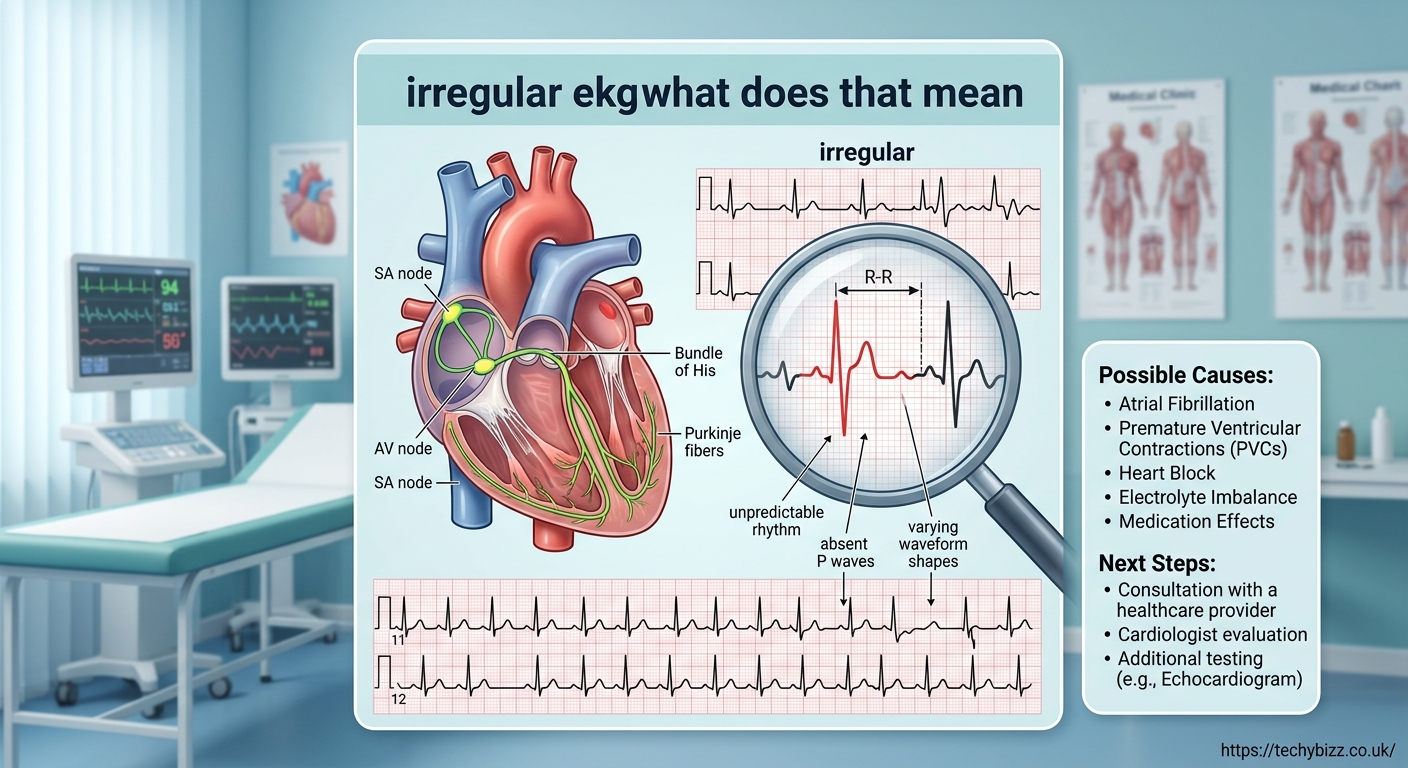
If you have been told that your EKG (electrocardiogram) is irregular, it is natural to wonder, “irregular EKG what does that mean?” An irregular EKG does not automatically mean that you have a serious heart problem. An EKG records the electrical activity of the heart and can show changes in heart rate, rhythm, or the way electrical signals travel through the heart. Some findings are temporary or harmless, while others may require further medical evaluation.
Understanding what an irregular EKG means can help you discuss the result more effectively with a healthcare professional. The exact meaning depends on the specific pattern seen on the test, your symptoms, medical history, medications, and other test results.
What Is an EKG?
An electrocardiogram, commonly called an EKG or ECG, is a noninvasive test that records the electrical signals produced by the heart. Small adhesive electrodes are placed on the skin of the chest and sometimes the arms and legs. These electrodes detect electrical activity and produce a tracing that healthcare professionals can interpret.
A normal heart rhythm usually follows a predictable electrical pattern. The EKG can provide information about the heart rate and rhythm and may identify certain abnormalities involving electrical conduction. It can also provide clues about previous or current heart problems.
An EKG is generally quick and painless. However, interpreting the result requires medical expertise because an unusual-looking tracing can have several possible explanations.
Irregular EKG What Does That Mean?
When someone asks “irregular EKG what does that mean,” the answer depends on what was actually irregular. The term itself is not a specific diagnosis.
An irregular EKG may refer to an abnormal heart rhythm, an unusually fast or slow heart rate, extra beats, skipped beats, or changes in the electrical conduction system. Sometimes an automated EKG machine reports an abnormality that needs to be reviewed by a qualified healthcare professional before its significance is determined.
For example, an EKG may show an irregular rhythm associated with atrial fibrillation. It may also detect premature beats, which can occur occasionally in otherwise healthy people. Other findings can be related to medication, electrolyte changes, underlying heart disease, or temporary factors.
Therefore, the phrase “irregular EKG” should be treated as a finding that needs context rather than as a diagnosis by itself.
Common Causes of an Irregular EKG
Several conditions and circumstances can contribute to an abnormal EKG. One common possibility is an abnormal heart rhythm, also called an arrhythmia. Arrhythmias occur when the heart beats too quickly, too slowly, or with an irregular pattern.
Atrial fibrillation is one example. In this condition, the upper chambers of the heart beat in an irregular way. Other possible rhythm disturbances include premature atrial contractions and premature ventricular contractions.
An EKG can also be affected by factors that are not necessarily caused by permanent heart disease. Electrolyte abnormalities, certain medications, stress, fever, caffeine, alcohol, and other factors can sometimes influence heart rhythm.
In some cases, an irregular EKG may be associated with structural or cardiovascular conditions. This is why healthcare professionals consider the complete clinical picture rather than interpreting a single EKG phrase in isolation.
Can Stress Cause an Irregular EKG?
Stress can affect heart rate and may contribute to sensations such as a racing or pounding heart. Anxiety can also make people more aware of normal or occasional extra heartbeats.
However, stress should not automatically be assumed to be the explanation for an abnormal EKG. If a healthcare professional identifies a rhythm abnormality, additional evaluation may be appropriate depending on the finding and the person’s symptoms.
Other temporary factors, including dehydration, illness, stimulant use, or changes in electrolyte levels, may also influence heart rhythm. A medical professional can determine whether the EKG finding appears temporary or requires further investigation.
Symptoms That May Occur With an Irregular Heart Rhythm
Some people with an irregular rhythm have no noticeable symptoms. An abnormal EKG may be discovered during a routine examination or before another medical procedure.
When symptoms occur, they can include a feeling of fluttering, pounding, racing, or skipped heartbeats. Some people may experience dizziness, weakness, unusual tiredness, shortness of breath, or reduced exercise tolerance.
More concerning symptoms can include chest discomfort, fainting, severe shortness of breath, or sudden weakness. These symptoms should not be ignored, particularly when they are new, severe, or occur together.
The presence or absence of symptoms does not by itself determine how important an EKG finding is. A person without symptoms can still have a condition that requires medical attention.
What Happens After an Irregular EKG?
If an EKG is described as irregular, a healthcare professional may first review the actual tracing rather than relying solely on the machine-generated interpretation. The clinician may ask about symptoms, medications, medical conditions, family history, and factors that could affect heart rhythm.
Depending on the situation, additional tests may be recommended. A Holter monitor or another ambulatory heart monitor can record heart activity for a longer period and may detect intermittent rhythm abnormalities that do not appear during a short EKG.
Other tests may include blood tests or an echocardiogram, which uses ultrasound to evaluate the heart’s structure and function. The appropriate evaluation depends on the specific EKG finding and the person’s overall health.
When Is an Irregular EKG More Concerning?
Not every irregular EKG represents an emergency. Some abnormal rhythms are occasional and may not require immediate treatment. However, certain findings can be clinically important, particularly when they occur with symptoms.
An irregular EKG deserves prompt medical attention when it is associated with symptoms such as fainting, significant chest pain, severe breathing difficulty, or a sustained rapid or abnormal heartbeat.
If someone develops severe chest pain, severe shortness of breath, fainting, or other potentially life-threatening symptoms, emergency medical care should be sought rather than waiting for a routine appointment.
Does an Irregular EKG Mean Heart Disease?
Not necessarily. An irregular EKG can occur for many reasons, and the finding alone does not establish a diagnosis of heart disease.
The heart’s electrical system is complex, and EKG patterns can be influenced by normal variations, temporary conditions, medications, electrolyte changes, and different types of arrhythmias. Some people can have occasional abnormal beats without having significant structural heart disease.
At the same time, an irregular EKG should not simply be dismissed. The significance depends on the specific pattern and the person’s circumstances. A healthcare professional can explain whether the finding is benign, needs monitoring, or requires further testing.
How Doctors Interpret an Irregular EKG
Healthcare professionals typically examine several aspects of an EKG. These can include the heart rate, rhythm, timing of electrical signals, and the appearance of different parts of the tracing.
They may also compare the new EKG with previous EKGs. A change from an earlier tracing can provide useful information.
Importantly, an automated EKG interpretation is not the same as a final medical diagnosis. Machines can identify patterns and flag possible abnormalities, but the result generally needs to be interpreted in the context of the patient’s symptoms and medical history.
What Should You Do If Your EKG Is Irregular?
If you have received an irregular EKG result, avoid assuming the worst based solely on the wording of the report. Ask the healthcare professional what specific abnormality was identified and whether it represents a heart rhythm problem or another type of EKG finding.
It can also be helpful to provide information about any symptoms, medications, supplements, caffeine or alcohol consumption, recent illness, and previous heart tests. This information can help the clinician determine what the finding may mean.
Do not start or stop heart medications based solely on an EKG report without medical guidance.
Frequently Asked Questions
Is an irregular EKG always serious?
No. An irregular EKG does not automatically indicate a serious condition. Some findings are minor or temporary, while others require additional testing or treatment.
Can an EKG detect an irregular heartbeat?
Yes. An EKG is one of the primary tests used to identify and characterize abnormal heart rhythms. However, some irregularities occur intermittently and may not appear during a short EKG.
Can anxiety cause an abnormal EKG?
Anxiety and stress can affect heart rate and awareness of heartbeats, but an abnormal EKG should not automatically be attributed to anxiety. The specific EKG finding should be assessed by a healthcare professional.
What should I ask my doctor about an irregular EKG?
Ask what specific abnormality was found, whether it represents an arrhythmia, whether additional testing is needed, and whether your symptoms or medications could be contributing to the finding.
Conclusion
So, irregular EKG what does that mean? In simple terms, it means that the electrical pattern recorded by the EKG differs from what is considered typical, but the phrase alone does not identify a specific disease. The finding could relate to heart rate, rhythm, electrical conduction, or another feature of the tracing.
The most important step is to understand the exact EKG finding and have it interpreted by a qualified healthcare professional. If an irregular EKG occurs with serious symptoms such as chest pain, fainting, or severe shortness of breath, seek urgent medical attention. An EKG result provides valuable information, but its meaning depends on the complete clinical picture.