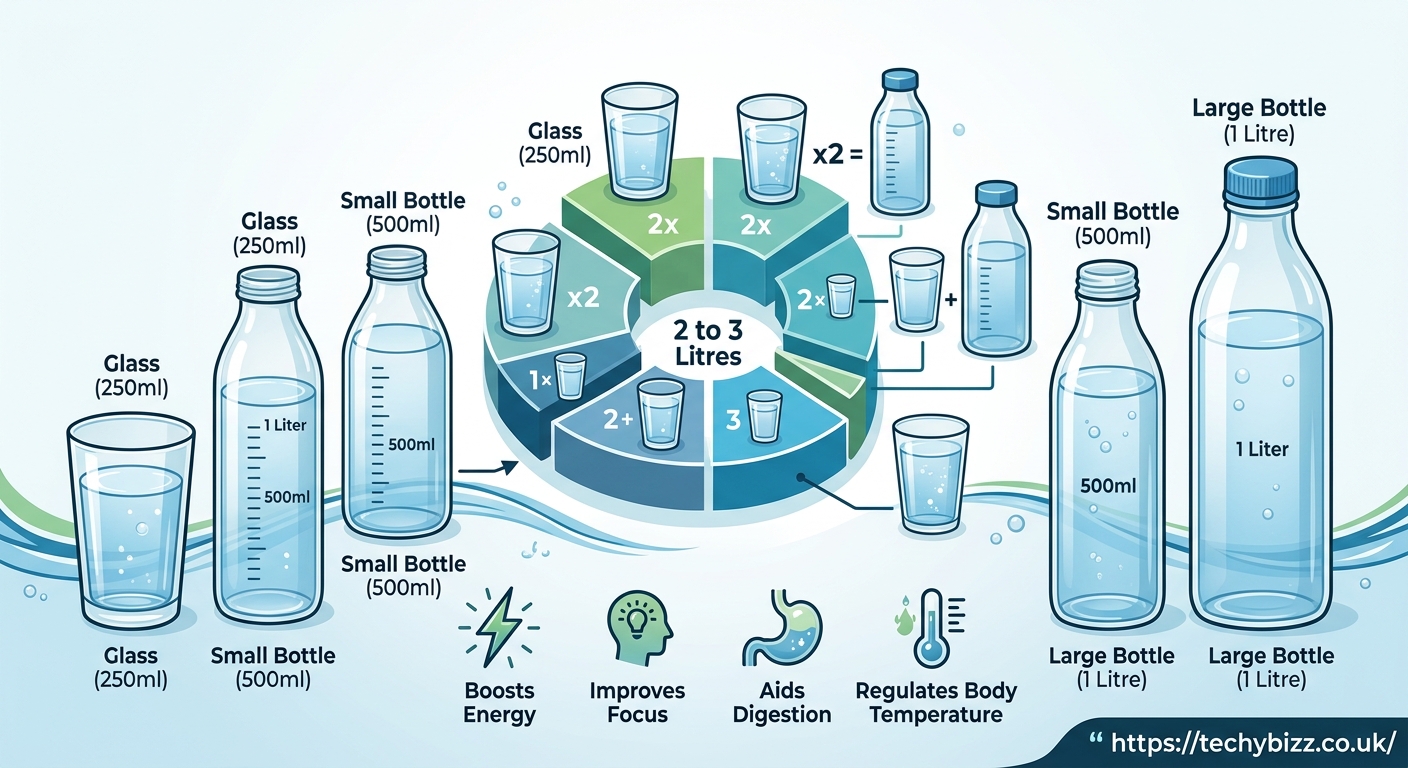
Water is essential for almost every function in the human body, from regulating body temperature and supporting digestion to helping the kidneys remove waste. Yet, the amount of water a person needs each day is not exactly the same for everyone. Age, sex, activity level, climate, diet, pregnancy, breastfeeding, and health conditions can all affect daily fluid needs. The CDC notes that water needs vary according to these factors, while foods such as fruits and vegetables also contribute to total water intake.
So, how much water to drink a day depends on your individual circumstances. A commonly used general guideline is around 6 to 8 glasses of fluid per day, while some scientific recommendations give higher totals when water from food and all beverages is included. Understanding the difference can make it easier to choose a realistic hydration routine.
How Much Water Should You Drink Each Day?
For many healthy adults, drinking around 6 to 8 glasses of fluid per day is a practical general guideline. NHS guidance recommends 6 to 8 glasses of fluid daily, and water, milk, tea, coffee, and other suitable drinks can contribute to the total.
However, this does not mean every person must drink exactly eight glasses of plain water. The body also receives water from food and other beverages. The National Academies’ reference values, for example, estimate total daily water intake—including food and beverages—at about 3.7 liters for men and 2.7 liters for women, although these are adequate-intake values rather than strict requirements for every individual.
Why Does Your Body Need Water?
Water plays an important role in maintaining normal body functions. It helps regulate body temperature, lubricate joints, protect sensitive tissues, transport nutrients, and remove waste through urine, sweat, and bowel movements. Drinking enough water also helps prevent dehydration, which can cause symptoms such as unclear thinking, mood changes, overheating, and constipation.
Hydration is particularly important when the body loses additional fluid. Exercise, hot weather, fever, vomiting, and diarrhea can all increase fluid losses. Someone working outdoors in a hot climate may therefore need considerably more fluid than someone spending most of the day indoors in a cool environment.
Does Everyone Need the Same Amount of Water?
No. There is no single water intake that is perfect for every person. A person’s daily requirement can change based on body size, physical activity, age, diet, environmental temperature, and other circumstances.
The National Academies specifically notes that individual water requirements can vary considerably from day to day. Its recommendations also distinguish between total water and water obtained specifically from beverages. This is important because water-rich foods contribute to hydration as well.
For example, a person who eats plenty of fruits, vegetables, soups, and other water-containing foods may obtain a significant amount of fluid through meals. Another person who eats fewer water-rich foods may need to obtain more of their daily fluid from drinks.
How Much Water Should You Drink During Exercise?
Exercise increases fluid loss, particularly through sweating. As a result, active people generally need more fluid than people with sedentary lifestyles. The amount required depends on exercise duration, intensity, temperature, humidity, clothing, and individual sweat rate.
If you exercise in hot weather, paying attention to thirst and replacing fluids regularly becomes especially important. The National Academies notes that physical activity and exposure to hot environments increase water losses and therefore increase fluid needs.
Instead of trying to follow one fixed number, consider your activity and surroundings. Carrying a reusable water bottle can make regular drinking easier, and the CDC recommends having water available throughout the day.
How Much Water Do You Need in Hot Weather?
Hot weather can significantly increase fluid requirements because the body loses more water through sweating. This is particularly relevant for people who work, exercise, or spend extended periods outdoors.
In warm climates, drinking regularly rather than waiting until you are extremely thirsty can help you maintain hydration. NHS guidance also recommends increasing fluid intake during warmer weather and physical activity.
People living in particularly hot environments should therefore avoid treating the standard 6-to-8-glass guideline as a rigid maximum. Actual needs can be higher when environmental conditions cause greater fluid losses.
What Are the Signs of Dehydration?
Thirst is one of the body’s natural signals that you need fluid. Other possible signs of dehydration include dark or strong-smelling urine, reduced urination, dry mouth, dry lips, dizziness, headache, and tiredness. NHS healthcare guidance commonly recommends monitoring urine color as one practical way to think about hydration.
Urine color is not a perfect medical test, but it can provide a useful everyday indication. Very dark urine, particularly when combined with thirst or reduced urination, may suggest that you need more fluids. Severe dehydration can become dangerous and may require medical attention.
Is Drinking More Water Always Better?
More water is not automatically better. The goal is adequate hydration, not drinking excessive amounts simply because a larger number sounds healthier.
A major point from the National Academies is that healthy people can maintain normal hydration across a relatively wide range of water intakes. Its adequate-intake figures should therefore not be interpreted as an exact daily requirement for every individual.
People with certain medical conditions may also receive different fluid recommendations from their healthcare professionals. For example, some individuals with kidney or heart problems may be advised to limit fluids. Anyone who has been given a medical fluid restriction should follow their clinician’s instructions rather than a general internet guideline.
What Drinks Count Toward Your Daily Fluid Intake?
Plain water is one of the easiest choices, but it is not the only beverage that contributes to hydration. NHS guidance says that water, lower-fat milk, tea, coffee, and other suitable drinks can contribute to daily fluid intake.
However, beverage quality matters too. Sugary drinks can add substantial calories and sugar without providing the same nutritional advantages as water. The CDC recommends choosing water instead of sugary drinks when possible.
Tea and coffee can also contribute to fluid intake at normal levels. The idea that caffeinated drinks automatically cause dehydration is too simplistic; UK government guidance notes that their fluid content generally offsets their mild diuretic effect at normal consumption levels.
Simple Ways to Drink More Water Every Day
If you struggle to drink enough fluids, small habits can make the process easier. Start the day with a glass of water, keep a reusable bottle nearby, and drink with meals. You can also choose water when eating away from home.
The CDC suggests practical strategies such as carrying a reusable water bottle, serving water with meals, choosing water instead of sugary drinks, and adding lemon or lime if you prefer flavored water.
Another useful approach is to spread your fluid intake throughout the day rather than trying to drink a large amount at once. Regular drinking can be easier on your routine and can help you respond naturally to thirst.
Water Intake for Different People
Water requirements can differ substantially between individuals. The following table provides a general overview rather than a strict prescription:
| Person or Situation | General Consideration |
|---|---|
| Healthy adults | Around 6–8 glasses of fluid is a common general guideline |
| Physically active people | Usually need additional fluids to replace losses |
| Hot climates | Fluid needs can increase because of sweating |
| Pregnant people | Fluid needs may change during pregnancy |
| Breastfeeding people | Additional fluid may be needed |
| People with vomiting or diarrhea | Increased fluid losses require attention |
| People with certain medical conditions | Follow individualized medical advice |
The National Academies provides specific adequate-intake values for total water, while the CDC emphasizes that requirements vary according to age, sex, pregnancy, activity, breastfeeding, climate, and other factors.
Frequently Asked Questions
How much water should I drink a day?
For many adults, 6 to 8 glasses of fluid per day is a practical general guideline. However, individual needs vary, and some people require more because of exercise, heat, illness, pregnancy, or breastfeeding.
Is 2 liters of water a day enough?
Around 2 liters of fluid can be a useful general target for many adults, but it is not a universal requirement. Some people need more, while others may obtain substantial water from food and other beverages.
Does coffee count as water?
Yes. Normal amounts of tea and coffee contribute to fluid intake. However, drinks high in added sugar may not be the healthiest way to meet hydration needs.
Should I drink more water when exercising?
Usually, yes. Exercise causes fluid loss through sweating, so active people generally need additional fluids, particularly during prolonged exercise or hot weather.
Can you drink too much water?
Yes. Excessive water consumption can be harmful, especially when large quantities are consumed rapidly. Hydration should be balanced rather than based on the idea that more water is always better.
Conclusion
The answer to how much water to drink a day is not one fixed number for everyone. For many healthy adults, 6 to 8 glasses of fluid per day is a practical starting guideline, while scientific reference values consider water from both food and beverages and show that requirements differ between people.
The most important factors are your activity level, climate, diet, age, pregnancy or breastfeeding status, and overall health. Drink regularly, pay attention to thirst and other signs of dehydration, increase fluids when you are losing more water through exercise or heat, and follow personalized medical advice if you have a condition that affects fluid requirements.