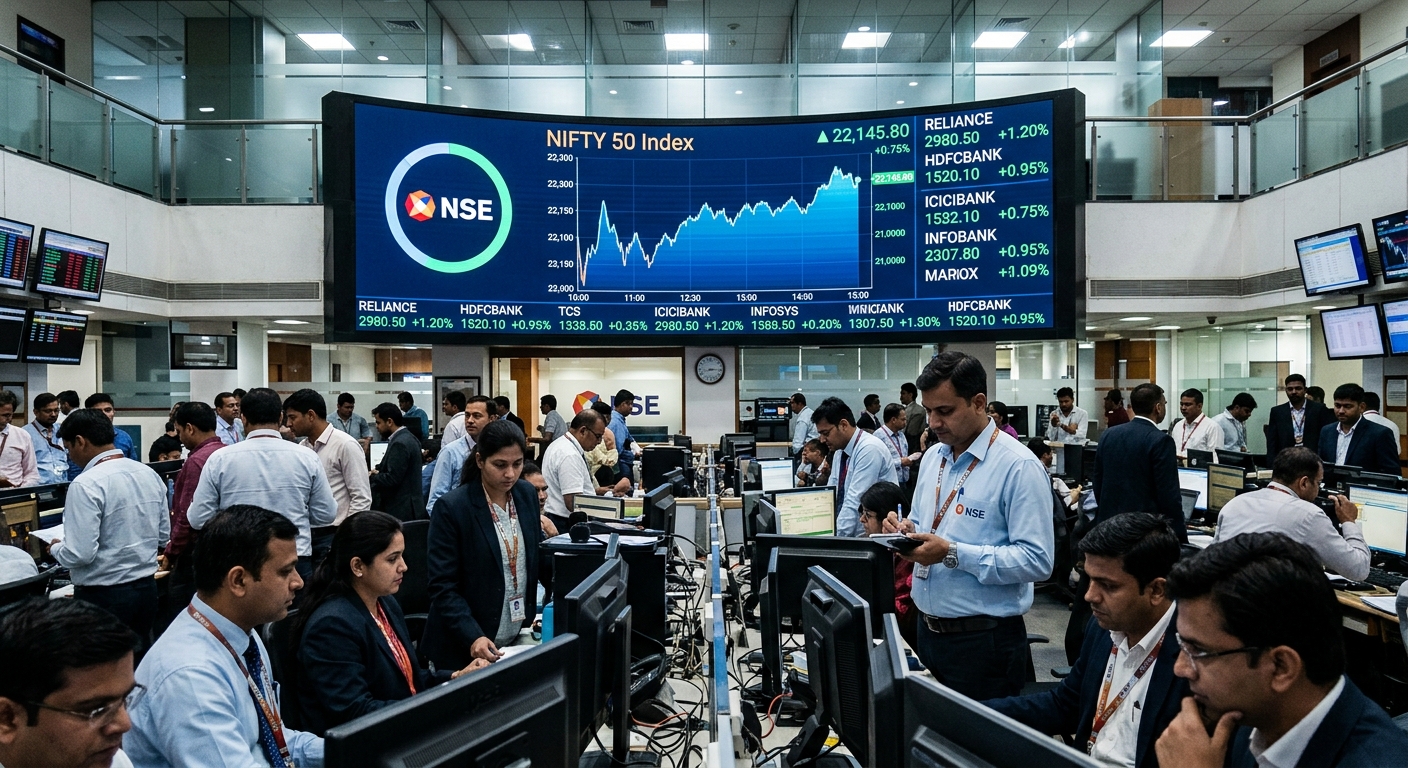
The Nifty 50 is one of the most widely followed stock market indices in India. It represents 50 large and liquid companies listed on the National Stock Exchange of India (NSE) and is commonly used as a benchmark for understanding the overall direction of the Indian equity market. NSE Indices describes Nifty 50 as a diversified index covering major sectors of the economy.
For investors, traders, analysts, mutual funds and financial institutions, the Nifty 50 provides a convenient way to track a broad group of leading Indian companies through a single index. However, it is important to understand that the Nifty 50 is an index, not a company or an investment product by itself. Its movement reflects changes in the prices and free-float market capitalisation of its constituent stocks.
What Is Nifty 50?
The Nifty 50 is the flagship equity index associated with the National Stock Exchange of India. It contains 50 securities representing large and liquid companies from different sectors of the Indian economy. The index is managed by NSE Indices Limited. According to NSE, Nifty 50 represented about 53.73% of the free-float market capitalisation of stocks listed on the NSE as of March 30, 2026.
The number “50” refers to the number of companies included in the index. These companies are not given equal weight. Instead, Nifty 50 uses a free-float market-capitalisation weighting methodology, meaning companies with greater eligible market value generally have a larger influence on the index.
This structure allows the index to represent large portions of India’s listed equity market while maintaining exposure across multiple industries.
History of Nifty 50
Nifty 50 has its roots in the development of India’s modern stock market. NSE began equity trading in November 1994, and research was subsequently undertaken to develop an index suitable for representing the Indian equity market and supporting index-based derivatives. NSE’s historical material states that Nifty 50 was launched in April 1996, with a base date of November 3, 1995 and a base value of 1,000.
The index has changed considerably over the years. Companies can enter or leave the index as market conditions and eligibility change. This helps the index continue to represent large and liquid companies rather than remaining permanently tied to its original constituents.
Nifty 50 is therefore not simply a list of the same 50 companies throughout its history. Its composition evolves according to documented index rules and periodic reviews.
How Does Nifty 50 Work?
Nifty 50 works by tracking the combined performance of its 50 constituent securities. Because the index uses free-float market capitalisation, each company has a different weight.
For example, a large company with a substantial free-float market capitalisation can have a greater effect on the index than a smaller constituent. Consequently, a significant movement in a heavily weighted constituent can influence the overall Nifty 50 more than a similar percentage movement in a company with a smaller index weight.
The index is calculated in real time during market hours. NSE’s index information identifies Nifty 50’s base value as 1,000 and its base year as 1995.
How Are Nifty 50 Companies Selected?
Selection for Nifty 50 is based on specific eligibility requirements rather than simply choosing companies based on popularity. Liquidity is an important consideration because an index should use securities with reliable and actively traded prices.
NSE explains that eligible companies need to satisfy defined criteria relating to market size, liquidity and other index requirements. The index is reviewed periodically so that companies that no longer meet the criteria can be replaced by eligible securities.
The methodology helps maintain continuity while allowing the index to reflect changes in India’s corporate landscape. A company can eventually become part of Nifty 50 as it grows in size and liquidity, while another company can leave if it no longer meets the applicable requirements.
How Is the Nifty 50 Calculated?
The Nifty 50 follows a free-float market-capitalisation methodology. In simple terms, the calculation considers the market value of shares that are actually available for public trading rather than treating all shares held by promoters or strategic investors as equally available.
NSE explains that free-float market capitalisation is obtained by applying investible weight factors to a company’s full market capitalisation. This approach reduces the influence of shares that are generally not available for trading.
The basic concept can be expressed as:
Index value = Free-float market capitalisation of index constituents ÷ Index divisor
The divisor is adjusted when necessary to account for corporate actions and changes in the index structure. This helps maintain continuity in the index when events such as constituent changes or certain corporate actions occur.
Why Is Nifty 50 Important?
The Nifty 50 is important because it provides a widely recognised reference point for India’s large-cap equity market. Investors can use it to compare the performance of individual portfolios, mutual funds and other investments with a broad market benchmark.
It is also used for index funds, exchange-traded products and derivatives. NSE identifies Nifty 50 as being suitable for benchmarking portfolios, index-based derivatives and index funds.
For financial news, the daily movement of Nifty 50 can also provide a quick indication of market sentiment. A rising index generally means the weighted prices of its constituents have increased, while a falling index indicates declines in the weighted portfolio value.
However, the Nifty 50 should not be interpreted as a complete representation of every listed company in India. Smaller companies and many sectors outside the large-cap segment can behave differently.
Nifty 50 and Different Sectors
One of the important characteristics of Nifty 50 is its diversification across multiple sectors. The index is designed to cover major areas of the Indian economy rather than focusing on a single industry. NSE currently describes Nifty 50 as a diversified 50-stock index covering 13 sectors.
Depending on the index composition at a particular time, major areas of the economy can include financial services, information technology, energy, automobiles, consumer products, telecommunications, healthcare and other industries.
Sector weights are not permanently fixed. They can change as the market values of companies change and as the index composition is periodically reviewed. Therefore, investors should check the latest official NSE information when they need the current constituents and weights.
Nifty 50 vs Nifty 500
Nifty 50 and Nifty 500 are both important NSE indices, but they have different coverage.
Nifty 50 tracks 50 large and liquid companies, while Nifty 500 covers 500 companies across large-, mid- and small-cap segments. NSE states that Nifty 500 represents approximately 92.04% of the free-float market capitalisation of stocks listed on the NSE as of March 30, 2026.
Therefore, Nifty 50 provides a more focused view of leading large-cap companies, whereas Nifty 500 provides much broader market coverage.
Neither index should automatically be treated as a substitute for the other. Their purposes and levels of diversification are different.
Nifty 50 for Investors and Traders
Investors commonly use Nifty 50 as a benchmark when evaluating equity-market performance. For example, someone holding a diversified portfolio may compare its long-term returns with the performance of an appropriate Nifty benchmark.
Nifty 50 is also important in passive investing. Index funds and exchange-traded funds can be designed to track the index, attempting to replicate its performance before fees and tracking differences.
Traders also follow Nifty 50 because futures and options are available based on the index. NSE lists index futures and index options among the products available on Nifty 50.
However, trading derivatives involves significant risks. The movement of an index can be affected by economic data, company results, interest rates, global markets and unexpected events.
Factors That Affect Nifty 50
Several factors can influence the Nifty 50. Corporate earnings are one of the most important because the index consists of major publicly traded companies.
Other influences include:
- Indian interest rates and monetary policy
- Inflation and economic growth
- Government policies and budgets
- Global stock markets
- Crude oil prices
- Foreign institutional investment flows
- Currency movements
- Corporate earnings
- Geopolitical developments
- Domestic economic indicators
Because Nifty 50 companies operate across different industries, individual events can affect constituents differently. A positive development for one sector may not necessarily benefit every company in the index.
NSE explains that movements in an index reflect changing market expectations about the future prospects of India’s corporate sector.
Nifty 50 Total Return Index
An important distinction for investors is the difference between the regular Nifty 50 Price Index and the Nifty 50 Total Returns (TR) Index.
The ordinary Nifty 50 Price Index reflects changes in the prices of its constituents. The Total Return Index additionally incorporates dividends, assuming those distributions are reinvested. NSE specifically notes that the Nifty 50 TR Index is a more appropriate benchmark when evaluating returns from investments that receive dividends.
This difference matters when comparing investment performance over long periods. A portfolio that receives dividends cannot always be fairly compared with a price-only index without considering the effect of those distributions.
Frequently Asked Questions About Nifty 50
What is Nifty 50?
Nifty 50 is an Indian stock market index consisting of 50 large and liquid companies listed on the NSE. It is widely used as a benchmark for the Indian equity market.
Who manages Nifty 50?
Nifty 50 is owned and managed by NSE Indices Limited, a subsidiary within the NSE group.
How many stocks are in Nifty 50?
The index contains 50 securities.
Is Nifty 50 equal-weighted?
No. Nifty 50 uses a free-float market-capitalisation weighting methodology, so constituents have different weights.
Can companies change in Nifty 50?
Yes. The index is reviewed periodically under defined rules, and eligible companies can replace existing constituents.
What is the Nifty 50 base value?
The Nifty 50 has a base value of 1,000, with a base date of November 3, 1995.
Conclusion
The Nifty 50 is a central benchmark for understanding the performance of India’s large-cap stock market. By combining 50 large and liquid companies from different sectors and weighting them according to free-float market capitalisation, the index provides a practical way to follow broad movements in Indian equities.
Its importance extends beyond daily market headlines. Nifty 50 is used for benchmarking, index funds, ETFs and derivatives, while its evolving composition allows it to reflect changes in India’s corporate and economic landscape. For anyone researching the Indian stock market, understanding the index’s methodology, constituent selection, weighting system and Total Return version provides a useful foundation for interpreting market performance.